
Under the Acacia Crown: Trees of Wadi Araba
Across the gravel plains and wadis of southern Jordan, acacia trees stand far apart. Yet each one gathers shade, soil, moisture, insects, birds, mammals, and traces of water into a small concentration of life.
An ecological reading of the native acacias of Wadi Araba, Jordan, exploring their relationship with water, landform, soil, shade, and other species. Rather than treating the trees as isolated botanical objects, the article looks at the small ecological worlds that form beneath and around their crowns.
- Written by
- mbtalafha
- Reading time
- 6 min read
- Place
- Wadi Araba Sub-District, Aqaba
Why this matters
An ecological reading of the native acacias of Wadi Araba, Jordan, exploring their relationship with water, landform, soil, shade, and other species. Rather than treating the trees as isolated botanical objects, the article looks at the small ecological worlds that form beneath and around their crowns.
Trees Across an Open Landscape
Wadi Araba is a landscape of distance. Gravel plains stretch toward mountain fronts. Dry channels cross broad alluvial surfaces. Vegetation appears intermittently, sometimes separated by hundreds of metres of exposed ground.
Within this openness, acacia trees become conspicuous landmarks.
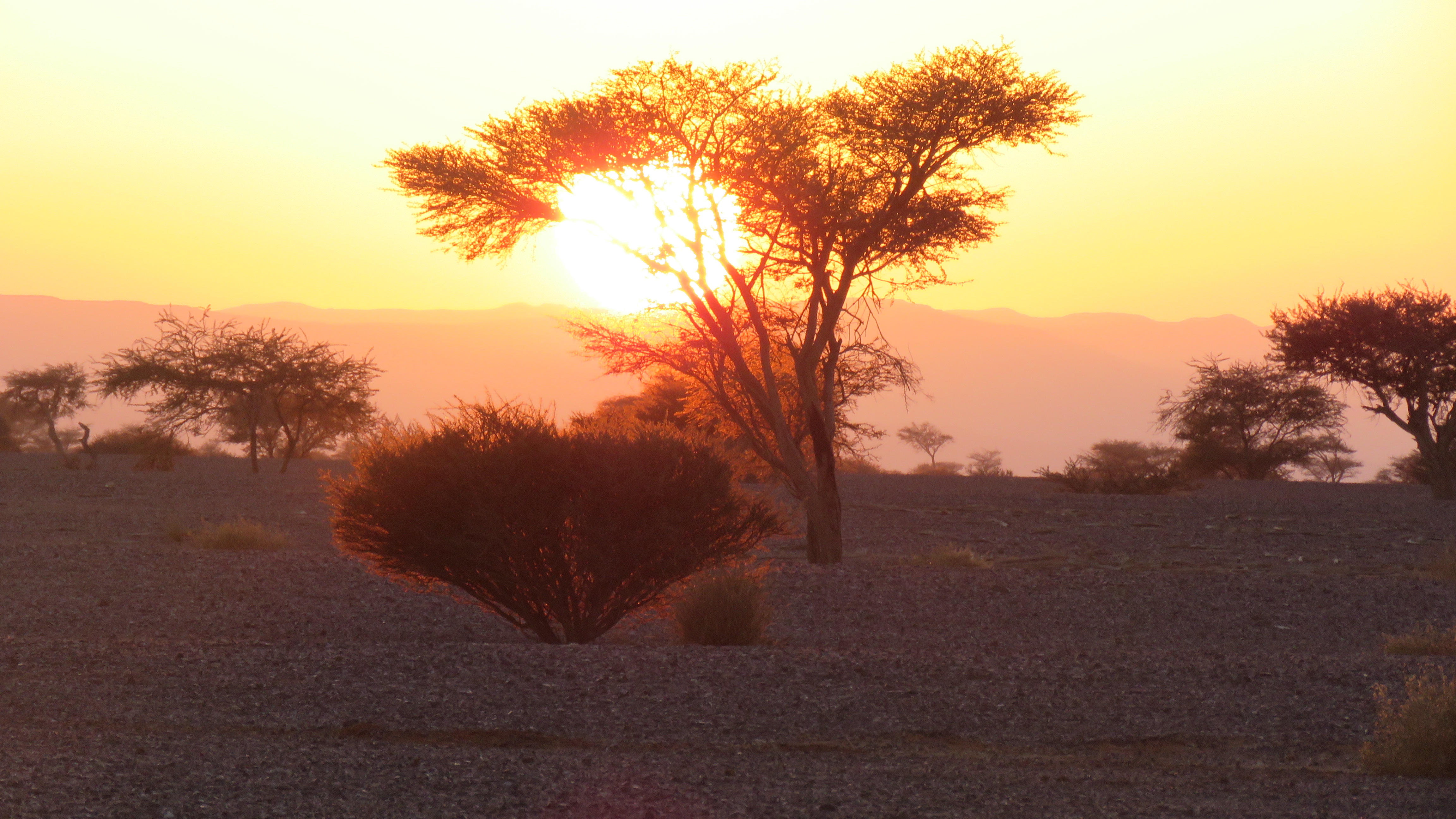
Two closely associated acacias are characteristic of southern Jordan: Acacia tortilis and Acacia raddiana, names that also appear in contemporary botanical classification within Vachellia tortilis and its related forms. They occur through Wadi Araba and other dry landscapes of southern Jordan, particularly around wadis, rocky terrain, gravel surfaces, and mountain bases.
Seen from a road or from a distant slope, they may look like solitary trees scattered almost randomly across the desert. On the ground, however, their distribution begins to make more sense. The trees are connected to drainage, sediment, topography, soil depth, and the episodic movement of water.
And beneath each mature crown, the desert itself changes.
Acacia Country
Acacia woodland in Jordan does not resemble the continuous forests that the word woodland can suggest. It is open, sparse, and strongly shaped by aridity.
Across Wadi Araba, individual trees may stand far apart, their crowns separated by wide expanses of gravel and sediment. Elsewhere, particularly where topography concentrates runoff or where mountain slopes meet deeper alluvial deposits, the trees can occur more frequently and begin to form loose stands.
This scattered pattern is part of the ecology of the landscape. In environments where rainfall is limited and highly variable, plants cannot occupy space independently of water availability. Their location reflects differences in soil depth, drainage, runoff, sediment accumulation, and access to moisture below the immediate surface.
The apparent emptiness between the trees is therefore meaningful. It tells us something about how selectively life occupies a dry landscape.
Where Water Has Passed
The presence of an acacia often invites a second question: why is the tree growing here?
Wadi Araba receives little rain, but its landscape has been repeatedly shaped by water. Rain falling over surrounding mountains moves downslope through gullies and wadis, carrying gravel, sand, silt, and organic material. Short-lived flows spread across alluvial fans or concentrate within channels before disappearing again.
Long after surface water has vanished, part of that moisture remains within sediments and deeper soil layers.
Acacias are adapted to this temporal geography of water. Their survival depends less on continuously wet ground than on access to moisture stored within the landscape after episodic rainfall and runoff.
This relationship makes the trees quietly informative. A line of acacias following a drainage route, a mature tree at the foot of a mountain, or several trees occupying part of an alluvial fan can reveal hydrological differences that are difficult to see when the ground is dry.
The tree is not a map of underground water, and its presence should not be interpreted so literally. But it can reveal where landform, sediment, and water have interacted long enough to support persistent woody life.
Field figure
Acacia Photograph in Wadi Araba, Jordan
Acacia Photograph in Wadi Araba, Jordan
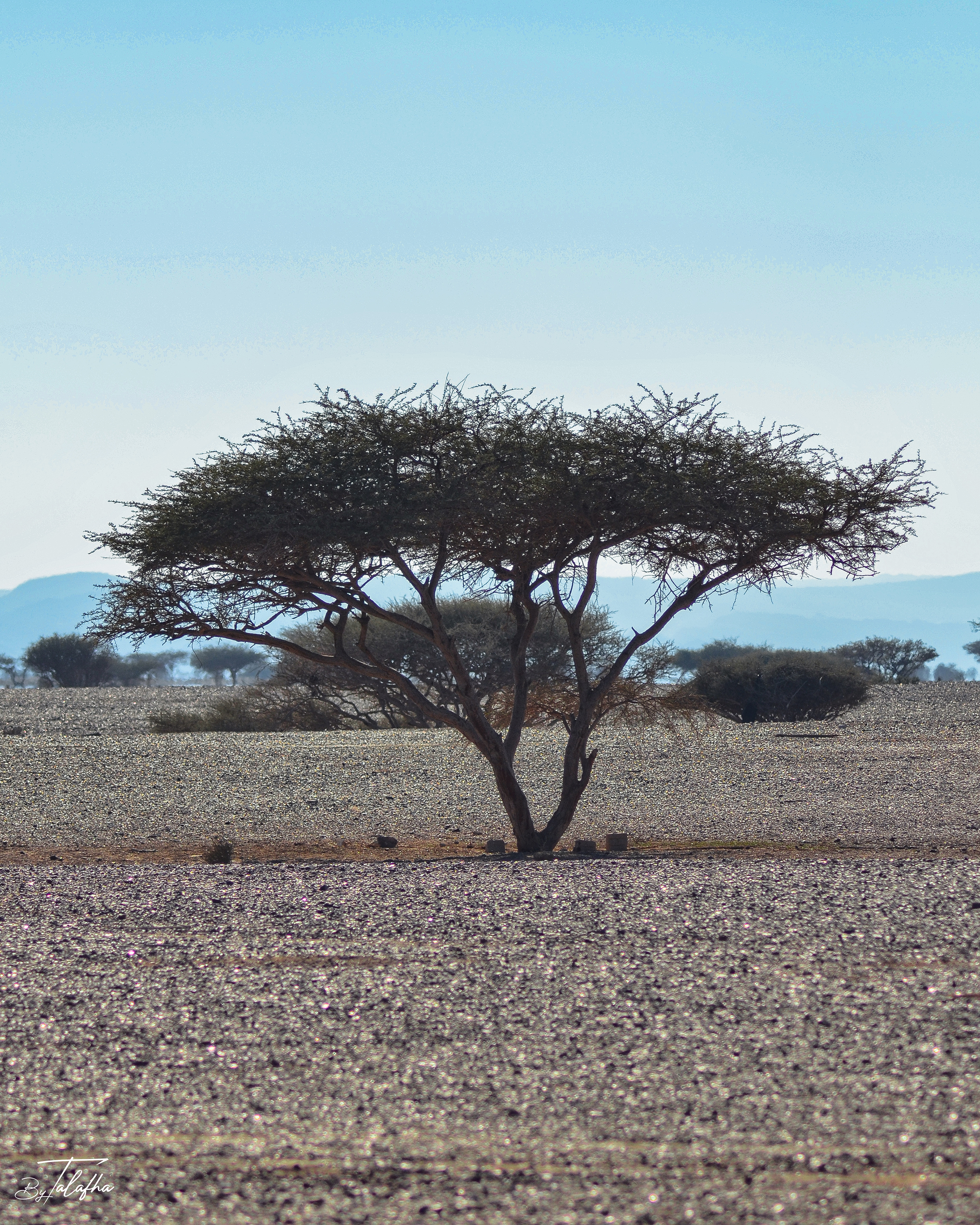
Acacia Photograph in Wadi Araba, Jordan
Under the Crown
Approaching a mature acacia changes the scale of observation.
From a distance, the crown is the dominant feature: broad, irregular, sometimes almost horizontal against the open sky. Beneath it, another landscape appears.
The light changes first. Small leaves filter direct sunlight into a shifting pattern of shade. Surface temperatures are moderated compared with fully exposed ground, particularly during the hottest hours of the day.
Then the soil begins to look different. Fallen leaflets, pods, twigs, and fragments of bark accumulate beneath the branches. Fine sediment can become trapped around roots and vegetation. Organic material remains where the surrounding open surface may be repeatedly swept by wind and runoff.
After rain, these differences can become more visible. Herbs and annual plants may emerge beneath or around the canopy. The relationship is not uniform, and a greener patch beneath a tree should not automatically be interpreted as greater biodiversity. What matters is that the tree modifies the conditions in which other organisms grow.
The shadow of the crown therefore has an ecological depth. Above it is foliage. Below it is a subtly altered combination of temperature, soil, organic matter, and moisture.
A Small Concentration of Life
In an open desert, ecological importance is often produced through concentration.
A mature acacia introduces vertical structure into a landscape where much of the vegetation remains close to the ground. Its branches provide places to perch, rest, feed, and hide. Flowers attract insects. Pods and foliage become food. Bark, dead branches, cavities, accumulated litter, and shaded soil create additional niches.
The activity around the tree is not always immediately visible. Some visitors arrive at night. Others leave only tracks, droppings, feathers, burrows, eaten pods, broken twigs, or small disturbances in the soil.
Research from the wider Araba landscape has demonstrated the importance of healthy acacia stands for arthropods and insectivorous bats, showing that the ecological influence of these trees can extend upward through a food web.
The tree does not function because every organism depends directly upon it. Rather, it brings together resources that are otherwise widely dispersed: shade, flowers, insects, organic material, elevated branches, shelter, and relatively moderated ground conditions.
A single crown can therefore become a small centre of activity within a much larger area of exposed desert.
Old Trees in a Slow Landscape
The apparent toughness of desert trees can hide their vulnerability.
Large acacias grow under conditions where establishment is difficult and successful regeneration cannot be assumed. A mature tree may represent many years of survival through drought, browsing, heat, flood, and disturbance.
Jordan's Plant Red List identifies Acacia tortilis as vulnerable nationally and associates much of its Jordanian distribution with the Wadi Araba landscape. Pressures include cutting for firewood, grazing, prolonged drought, and other disturbances that affect both mature trees and the conditions required for younger trees to establish.
Damage can also occur indirectly. Roads and vehicle tracks compact soil. Construction can interrupt surface drainage. Earthworks may redirect runoff away from established trees or concentrate it in unfamiliar ways. Repeated grazing can suppress regeneration even when mature trees remain standing.
For this reason, the persistence of an acacia landscape cannot be understood simply by counting existing trees. The presence of old individuals tells only part of the story. Young trees, seedlings, hydrological continuity, soil condition, and the space between generations matter as well.
What the Trees Reveal
Acacias make some of Wadi Araba's hidden relationships visible.
Their distribution connects vegetation to topography. Their roots connect the visible landscape to water stored below the surface. Their crowns transform solar exposure into shade. Their litter changes the ground beneath them. Their branches and flowers attract other forms of life.
The result is a landscape in which a tree cannot easily be separated from the processes surrounding it.
Stand beneath an old acacia and the desert no longer appears uniformly dry or empty. There are gradients: brighter and darker ground, coarse and fine sediment, exposed surfaces and protected ones, places that shed water and places that receive it, open space and concentrated habitat.
These differences are small compared with the scale of Wadi Araba, but that is precisely why they matter. Dryland ecologies are often structured by modest variations in conditions rather than dramatic boundaries.
The acacia crown makes one of those variations visible.
References
Sources for continued reading.
- 01Source ↗
Royal Botanic Garden Jordan. Jordan Plant Red List, Volume 1.
- 02Source ↗
Ministry of Environment, Jordan. Jordan's Fourth National Communication on Climate Change.
- 03Source ↗
Taifour, H. and El-Oqlah, A. The Plants of Jordan: An Annotated Checklist.
- 04Source ↗
Hackett, T. D., Korine, C., and Holderied, M. W. 2013. The Importance of Acacia Trees for Insectivorous Bats and Arthropods in the Arava Desert. PLoS ONE 8(2): e52999.
Connected Knowledge
Continue through the relationships surrounding this record.
Follow what this record touches next.
Land
Land records relationships between ecology, ownership, terrain, history, biodiversity, and development.
Continue →