
A Dead Tree Is Still Habitat
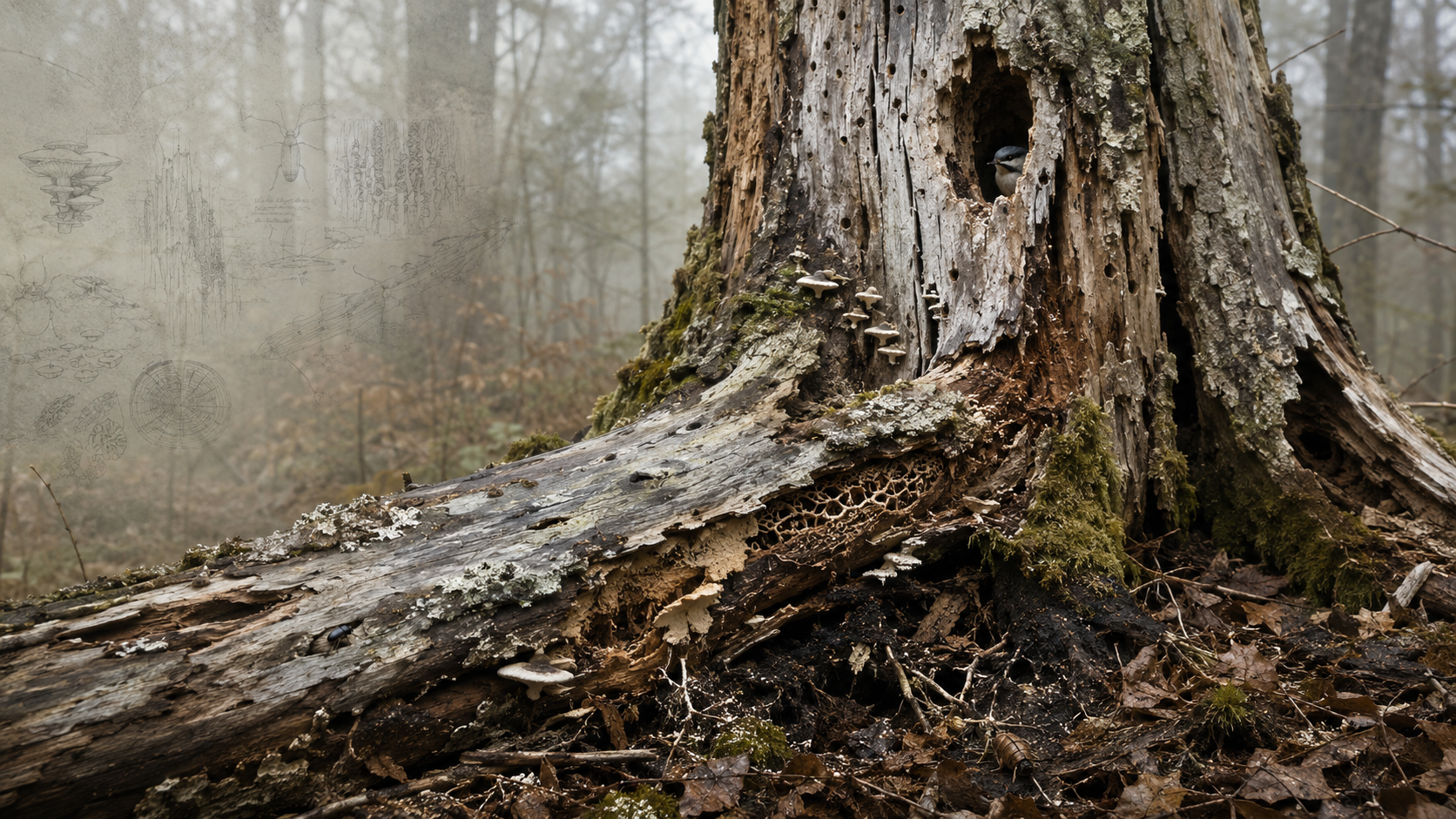
The death of a tree does not end its ecological life. It changes it. Bark loosens, cavities deepen, fungi enter, insects arrive, moisture collects, birds investigate, and wood slowly becomes part of the soil.
A short ecological reading of deadwood as habitat rather than waste. Standing snags, fallen trunks, cavities, bark, fungi, decaying heartwood, and contact with soil create a changing sequence of habitats used by organisms at different stages of decomposition. The article invites a slower way of looking at dead trees, not as empty remains, but as structures still participating in biodiversity, nutrient cycling, carbon dynamics, and forest renewal.
- Written by
- mbtalafha
- Reading time
- 5 min read
Why this matters
A short ecological reading of deadwood as habitat rather than waste. Standing snags, fallen trunks, cavities, bark, fungi, decaying heartwood, and contact with soil create a changing sequence of habitats used by organisms at different stages of decomposition. The article invites a slower way of looking at dead trees, not as empty remains, but as structures still participating in biodiversity, nutrient cycling, carbon dynamics, and forest renewal.
Death opens the tree
A living tree is already an ecosystem. Its bark holds lichens and insects, its crown shelters birds, its roots interact with fungi, and its leaves transform sunlight into stored carbon.
When the tree dies, much of that ecological activity does not disappear. It changes direction.
The crown may break. Bark begins to loosen. Heartwood softens. Fungi enter exposed tissue. Beetles and other invertebrates use the wood. Cavities deepen. Rain enters places that were once sealed. The trunk may remain standing for years before falling, and once on the ground its underside develops a completely different microclimate from its exposed upper surface.
What looks like decline from a distance is, at close range, a multiplication of niches.
Standing, fallen, hollow
Deadwood is not one habitat.
A standing dead tree, often called a snag, offers height, cavities, cracks, exposed branches, loose bark, and elevated perches. A fallen trunk creates contact with soil, shade, moisture gradients, protected spaces, and a long horizontal surface that changes as decay progresses. A hollow tree may contain decayed wood, accumulated organic material, fungi, insects, and stable interior conditions very different from the surrounding forest.
These differences matter. Research on deadwood biodiversity consistently shows that quantity is important, but so are qualities such as whether wood is standing or fallen, its size, tree species, degree of decay, sun exposure, moisture, and the presence of cavities.
A forest containing many forms and stages of deadwood therefore offers a richer set of ecological conditions than one in which dead trees are routinely removed.
Decay creates habitat
Decomposition is often described as disappearance. Ecologically, it is closer to transformation.
Fungi and microorganisms begin altering the structure and chemistry of wood. Invertebrates tunnel beneath bark and into softened tissue. Their galleries create new surfaces and passages. Wood becomes increasingly porous, moisture conditions change, and pieces begin to detach.
Different organisms arrive at different stages. Freshly dead wood does not offer the same habitat as a heavily decomposed log. A hard snag with intact bark is physically different from a soft trunk that can be pulled apart by hand. Intermediate stages can be especially rich because several structural conditions overlap.
The important unit is therefore not simply the dead tree. It is the sequence of change taking place within it.
The cavity becomes a small world
Tree cavities concentrate this transformation into remarkably small spaces.
A hollow may begin with a broken branch, wound, fungal infection, fire scar, or gradual internal decay. Over time it can accumulate softened wood, leaf fragments, insect remains, animal material, moisture, and fungal growth.
For some organisms, these cavities are specialized habitat rather than incidental shelter. Research on deadwood-dependent invertebrates shows that tree hollows can support species-rich communities whose occurrence depends on characteristics of the cavity, the host tree, and the surrounding landscape.
From outside, a hollow may appear to be a defect. Ecologically, the missing wood is precisely what creates the habitat.
A fallen trunk begins to join the soil
Once a trunk reaches the forest floor, the boundary between tree and soil gradually becomes less distinct.
The side touching the ground remains cooler and often moister than the exposed surface. Fungi spread through the wood. Invertebrates occupy cracks and softened material. Mosses and seedlings may establish on sufficiently decomposed surfaces. Fine roots can enter decaying wood, and fragments become incorporated into the forest floor.
Deadwood is also part of the carbon cycle. Carbon stored while the tree was alive remains in the wood for a period and is gradually released or transferred through decomposition, biological consumption, combustion, fragmentation, and incorporation into other ecosystem pools.
The fallen tree is therefore neither permanent carbon storage nor ecological waste. It is a temporary reservoir moving through a larger cycle.
Look closer before walking past
The most interesting dead tree may be the one that first appears to contain nothing.
Move closer without disturbing it. Look for entrance holes beneath peeling bark, fine sawdust or frass, fungal fruiting bodies, cavities, polished edges around openings, scratch marks, webs, moss, lichens, stored seeds, feathers, droppings, shed insect skins, or subtle changes in moisture and wood texture.
Then change your angle. Look upward into broken limbs. Examine the shaded underside of a fallen log. Notice where the trunk touches soil and where it remains suspended above it. Compare hard wood with softened sections. Observe which side receives sun and which remains damp.
A photograph of a dead tree can document far more than the tree itself. It can record the architecture of decay.
Not everything dead should be cleaned away
There are places where dead trees genuinely require intervention. A structurally unstable snag beside a trail, road, building, or heavily used public space can create a safety risk. In some landscapes, fuel management and wildfire objectives also influence how dead material is handled.
But removing deadwood simply because it looks untidy replaces an ecological judgment with an aesthetic one.
A healthier question is more specific: what is this piece of wood doing here?
Is it dangerous? Is it providing a cavity? Is it shaded and decomposing? Does it bridge wet soil and dry ground? Is it one of very few old logs left in the area? Could a hazardous standing section be reduced while retaining some trunk or fallen wood?
Ecology rarely asks us to preserve every object unchanged. It asks us to notice function before we erase it.
References
Sources for continued reading.
- 01Source ↗
Stokland, J. N., Siitonen, J., and Jonsson, B. G. 2012. Biodiversity in Dead Wood. Cambridge University Press.
- 02Source ↗
Parajuli, R. and Markwith, S. H. 2023. Quantity is foremost but quality matters: A global meta-analysis of correlations of dead wood volume and biodiversity in forest ecosystems. Biological Conservation, 283, 110100.
- 03Source ↗
Wijas, B. J., Allison, S. D., Austin, A. T., Cornwell, W. K., Cornelissen, J. H. C., Eggleton, P., Fraver, S., Ooi, M. K. J., Powell, J. R., Woodall, C. W., and Zanne, A. E. 2024. The Role of Deadwood in the Carbon Cycle: Implications for Models, Forest Management, and Future Climates. Annual Review of Ecology, Evolution, and Systematics, 55, 133-155.
- 04Source ↗
Ranius, T. et al. 2024. Habitat requirements of deadwood-dependent invertebrates that occupy tree hollows. Biological Reviews.
Connected Knowledge
Continue through the relationships surrounding this record.
Follow what this record touches next.
Ideas
Planning concepts and methods influence what planners notice, measure, value, and act upon.
Continue →