
Constructed Wetlands: When Wastewater Treatment Becomes Landscape
A wastewater treatment system does not have to hide behind concrete walls and mechanical equipment. In a constructed wetland, treatment can become a living landscape where water, plants, microorganisms, soil, and time do much of the work.
A Field Guide to constructed wetlands as nature-based wastewater infrastructure. It explains how engineered wetland systems treat wastewater through physical, biological, and chemical processes while offering opportunities for low-energy operation, decentralized treatment, water reuse, biodiversity enhancement, landscape integration, and circular resource management. It also examines their limitations, including land requirements, pretreatment, clogging, maintenance, and the need to match treatment performance with intended reuse.
- Written by
- mbtalafha
- Reading time
- 9 min read
Why this matters
A Field Guide to constructed wetlands as nature-based wastewater infrastructure. It explains how engineered wetland systems treat wastewater through physical, biological, and chemical processes while offering opportunities for low-energy operation, decentralized treatment, water reuse, biodiversity enhancement, landscape integration, and circular resource management. It also examines their limitations, including land requirements, pretreatment, clogging, maintenance, and the need to match treatment performance with intended reuse.
Wastewater treatment can be a landscape
Conventional wastewater treatment is often imagined as a sequence of tanks, pumps, aerators, pipes, and mechanical equipment. Constructed wetlands begin from a different proposition: treatment can also be organized through ecological processes.
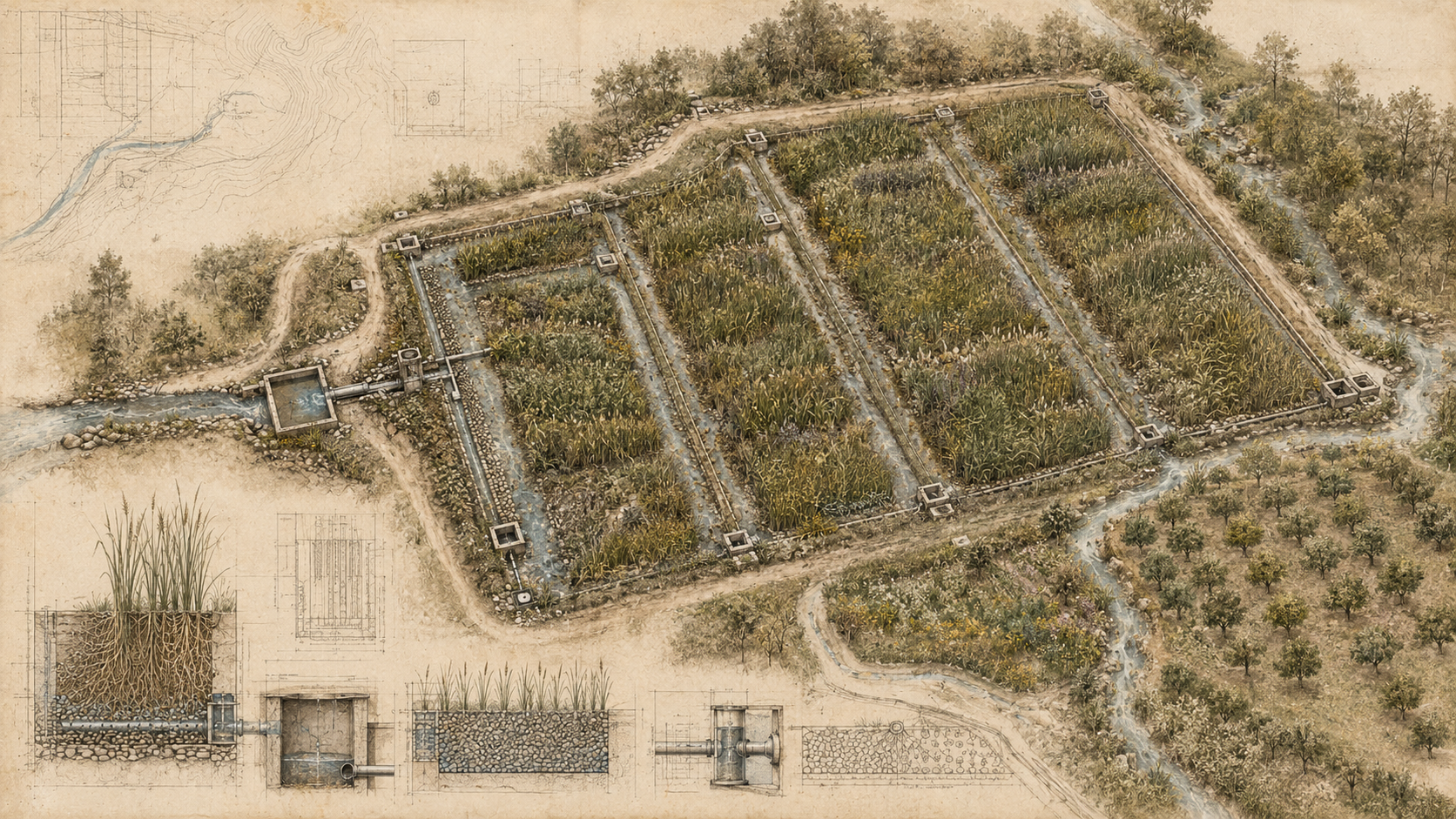
A constructed wetland is an engineered treatment system designed to use combinations of vegetation, porous media, microorganisms, water movement, sedimentation, filtration, adsorption, and biological transformation to improve water quality. It borrows processes associated with natural wetlands but arranges them intentionally for treatment.
This makes constructed wetlands more than planted ponds. Their hydraulic design, media, vegetation, loading, pretreatment, retention time, oxygen conditions, and outlet configuration determine how they perform.
What makes them especially interesting for planning is that the treatment process occupies land in a visible way. Infrastructure becomes landscape, and that creates possibilities that extend beyond pollutant removal.
Treatment happens through several processes at once
Constructed wetlands do not depend on one treatment mechanism. Their strength comes from several processes operating together.
Suspended material can settle or become trapped within porous media. Organic matter is transformed by microbial communities. Nitrogen can be converted through processes such as nitrification and denitrification when appropriate aerobic and anoxic conditions are present. Phosphorus can be retained through plant uptake, microbial processes, precipitation, and adsorption to the substrate, although long-term phosphorus retention can become limited as media become saturated.
Plant roots create physical structure and influence conditions around the rhizosphere, while microbial biofilms developing on roots and media perform much of the biochemical treatment.
The wetland should therefore be understood as a treatment ecology. Water quality emerges from the relationship among hydraulic loading, retention time, oxygen, temperature, substrate, vegetation, microorganisms, and the characteristics of the wastewater entering the system.
Not every constructed wetland works the same way
Constructed wetlands can be configured in several ways. Free-water-surface wetlands resemble shallow vegetated basins in which water remains visible above the substrate. Subsurface-flow wetlands move wastewater through gravel, sand, or another porous medium beneath the surface.
Horizontal subsurface-flow wetlands generally move water laterally through a planted bed. Vertical-flow wetlands distribute wastewater across the surface and allow it to percolate downward through the media. Hybrid systems combine configurations so that different treatment environments can complement one another.
These differences matter. Oxygen transfer, hydraulic loading, nitrogen transformation, land requirements, clogging risk, exposure pathways, and treatment performance can vary substantially among configurations.
The question is therefore not whether constructed wetlands work in the abstract. It is which wetland configuration is appropriate for the wastewater, treatment objective, climate, available land, required effluent quality, and intended reuse.
Low operation does not mean no operation
One of the major attractions of constructed wetlands is their potential for relatively low energy demand and simpler operation compared with treatment systems that rely heavily on mechanical aeration, pumping, chemicals, and complex electromechanical equipment.
This can make them particularly valuable for decentralized systems, smaller settlements, institutions, peri-urban locations, agricultural settings, and places where long-term access to highly specialized operators or energy-intensive equipment is difficult.
But low operation and maintenance should never be translated into no maintenance. Inlets can clog. Pretreatment units accumulate solids. Vegetation requires management. Hydraulic short-circuiting can develop. Media can become blocked. Pumps, where used, can fail. Outlet levels need inspection. Sediment and sludge still need appropriate management.
A well-designed wetland succeeds partly because its maintenance requirements are understandable, reachable, and compatible with the institutional capacity responsible for operating it.
The inlet often determines the future of the wetland
When reading a constructed wetland in the field, begin before the planted bed.
What arrives at the wetland? Has wastewater received screening, settling, septic treatment, or another form of pretreatment? How are solids prevented from immediately entering the porous media? Is the flow distributed evenly across the inlet? Are there signs of ponding, odor, erosion, bypass, or clogging?
Constructed wetlands are often strongest when they operate as part of a treatment train rather than being expected to receive every pollutant load directly. Pretreatment can protect the wetland from excessive solids and reduce the risk of clogging, while downstream polishing or disinfection may be required when stringent reuse or pathogen standards apply.
This is an important planning lesson. Nature-based infrastructure still depends on sequencing. A wetland is not a substitute for thinking about the entire wastewater pathway.
Treatment can create habitat, but biodiversity is not automatic
Constructed wetlands can create vegetation, water, soil, edge conditions, shelter, feeding opportunities, and ecological structure within landscapes that may otherwise contain little habitat. Carefully designed systems can support insects, birds, amphibians, microorganisms, and diverse plant communities while contributing to ecological connectivity and landscape quality.
But biodiversity should not be treated as an automatic outcome of adding wetland plants to wastewater infrastructure. Habitat value depends on configuration, vegetation diversity, water quality, hydroperiod, surrounding land uses, disturbance, accessibility, maintenance, and whether wildlife exposure to untreated or insufficiently treated wastewater creates risks.
Subsurface-flow systems, for example, may provide less open-water habitat than free-water-surface wetlands but can reduce direct human and animal contact with wastewater. Treatment and ecological objectives must therefore be designed together rather than assumed to be identical.
The strongest projects ask two questions at once: what conditions are required to treat the water, and what ecological conditions can responsibly coexist with that treatment function?
Treated wastewater can become a resource
The circular value of a constructed wetland becomes particularly important in water-scarce regions. Wastewater enters as a liability, but after appropriate treatment it can potentially become a non-conventional water resource.
Depending on treatment performance, regulation, health protection, salinity, pathogens, nutrients, and the intended end use, treated effluent may support irrigation, landscape watering, environmental uses, agricultural applications, or other non-potable demands. Additional polishing or disinfection may be needed before reuse.
The planning significance is larger than the wetland itself. If treated water can be used near the point of generation, wastewater management begins to connect with irrigation planning, urban landscape management, food production, groundwater protection, and water-demand reduction.
Reuse should therefore be considered during design rather than added after treatment is complete. The intended reuse determines the treatment target.
The circular economy extends beyond water
Constructed wetlands also invite a wider understanding of resource flows. Nutrients entering in wastewater become part of plant, microbial, sediment, and effluent pathways. Vegetation produces biomass. Treatment landscapes may support habitat. Reused water can replace some demand for higher-quality freshwater.
Research increasingly examines opportunities for nutrient recovery, biomass valorization, bioenergy, carbon management, and the use of recycled or locally available materials within wetland substrates. These opportunities should be evaluated carefully because the presence of contaminants can limit how biomass, sediment, or other materials can safely be reused.
Circularity is therefore not simply the claim that nothing becomes waste. It is the deliberate design of safe loops where water, nutrients, materials, and ecological functions can be recovered without transferring contamination from one part of the system to another.
Constructed wetlands are valuable because they make those flows spatially visible.
The land requirement is a planning question
Constructed wetlands are often described as low-energy systems, but their trade-off can be land. Passive treatment generally requires space for hydraulic retention, media, vegetation, access, pretreatment, and maintenance.
That does not make land requirement inherently negative. The same land can sometimes provide treatment, habitat, landscape structure, education, cooling, open space, or water reuse functions. But those benefits should not be used to disguise real spatial requirements.
Density, land value, groundwater conditions, flood risk, nearby sensitive uses, topography, access, odor control, mosquito management where relevant, and future expansion all influence whether a site is suitable.
This is where planning becomes central. The wetland must be located before the land around it becomes unavailable, fragmented, inaccessible, or incompatible with treatment infrastructure.
Read the wetland as a complete treatment landscape
A constructed wetland should be observed from inlet to reuse or discharge point.
Trace the wastewater source, pretreatment, distribution system, treatment cells, vegetation, media, water level, outlet controls, sampling points, access routes, bypasses, sludge or sediment management, and the destination of treated effluent. Look for uneven vegetation, standing water where subsurface flow was intended, blocked distribution pipes, erosion, odors, exposed wastewater, dead zones, damaged liners, and inaccessible control structures.
Then look beyond treatment performance. Where does the reused water go? What habitat has developed? Is the site connected to surrounding ecological structure? Can operators reach every component? Is there room for maintenance and future adaptation?
The wetland works as infrastructure only when the hydraulic, ecological, operational, and spatial systems work together.
From knowledge to action
Practical applications
Evaluate constructed wetlands early in decentralized wastewater planning where land is available and long-term energy and operational capacity are important constraints.
Plan pretreatment and wetland treatment as one system so excessive solids and organic loading do not undermine long-term wetland performance.
Select wetland configuration according to wastewater characteristics, climate, hydraulic loading, treatment targets, available land, and intended reuse.
Design maintenance access, inlet inspection, flow distribution, outlet control, sampling, vegetation management, and clogging response from the beginning.
Connect treated-effluent quality directly to a defined reuse pathway rather than describing water reuse only as a future possibility.
Consider biodiversity and habitat enhancement as explicit design objectives while protecting wildlife and people from inappropriate exposure to wastewater.
Integrate constructed wetlands with landscape, irrigation, ecological connectivity, and open-space planning where these functions are compatible.
Assess the life-cycle implications of media, liners, pumps, aeration, vegetation, land occupation, and construction materials rather than assuming every nature-based system automatically has a low environmental footprint.
Explore safe circular-economy opportunities for treated water, nutrients, biomass, and locally sourced or recycled media where contaminant risks are understood.
Protect sufficient land for treatment, access, buffers, maintenance, and future expansion before urban development eliminates suitable decentralized treatment sites.
Carry into the field
Questions for planners
What wastewater is entering the wetland, and what pretreatment does it require?
Which constructed-wetland configuration best matches the treatment objective and available land?
What pollutant-removal processes are expected to occur within each treatment stage?
Can operators easily inspect and maintain the inlet, media, vegetation, outlets, and pretreatment units?
What happens if the wetland begins to clog or receives a hydraulic or pollutant load beyond its design condition?
What level of effluent quality is required for the intended reuse?
Is additional polishing or disinfection necessary before treated water reaches people, crops, landscapes, or the environment?
What biodiversity benefits can realistically be created without compromising treatment or creating unsafe exposure?
Can treated water, nutrients, vegetation, or other system outputs participate safely in local circular-resource flows?
Does the land-use plan recognize the wetland as permanent infrastructure requiring space, access, protection, and long-term stewardship?
References
Sources for continued reading.
- 01
Kadlec, R. H. and Wallace, S. D. 2009. Treatment Wetlands, Second Edition. CRC Press. A foundational engineering reference on wetland treatment processes, hydraulics, design, pollutant removal, and operation.
- 02Source ↗
Wu, H., Zhang, J., Ngo, H. H., Guo, W., Hu, Z., Liang, S., Fan, J., and Liu, H. 2015. A review on the sustainability of constructed wetlands for wastewater treatment: Design and operation. Bioresource Technology, 175, 594-601.
- 03Source ↗
Garfí, M., Ziegler-Rodriguez, K., and Josa, I. 2026. Life cycle assessment of constructed wetlands for wastewater treatment: Environmental, social and economic opportunities and challenges. Current Opinion in Environmental Sustainability, 100713.
- 04Source ↗
Nature-based solutions for municipal wastewater treatment: A systematic review on full-scale systems from the last 30 years (1995-2025). 2026. Nature-Based Solutions, 9, 100311. The review identifies hundreds of full-scale nature-based municipal wastewater systems and documents multiple constructed-wetland configurations, substrates, and plant species.
- 05Source ↗
Constructed wetlands as a nature-based solution for sustainable use of non-conventional water in arid and semi-arid regions: A scoping review. 2026. Next Sustainability, 7, 100348. The review examines constructed wetlands for treatment and reuse of greywater, municipal effluent, and agricultural drainage in water-scarce regions.
Connected Knowledge
Continue through the relationships surrounding this record.
Follow what this record touches next.
Ideas
Planning concepts and methods influence what planners notice, measure, value, and act upon.
Continue →