
From Shower to Reuse: Inside a Small Greywater Wetland
The water leaving a shower is not drinking water, but it is not sewage in the same sense as toilet wastewater either. Separate it early, treat it through a living filter, and part of a building's wastewater can become a local water resource.
A visual walkthrough of a small vertical-flow constructed wetland for household greywater. The article follows water from source separation and pretreatment through sand, gravel, roots, and microbial biofilms, then into polishing, storage, and non-potable reuse. It also explains what these systems do well, where they fail, and why a planted bed should never be mistaken for a self-maintaining garden.
- Written by
- mbtalafha
- Reading time
- 8 min read
Why this matters
A visual walkthrough of a small vertical-flow constructed wetland for household greywater. The article follows water from source separation and pretreatment through sand, gravel, roots, and microbial biofilms, then into polishing, storage, and non-potable reuse. It also explains what these systems do well, where they fail, and why a planted bed should never be mistaken for a self-maintaining garden.
A Different Pipe Leaves the Bathroom
A household usually sends almost every wastewater stream toward the same destination. Shower water, toilet wastewater, laundry water, and wash-basin flows disappear into drains and become one mixed volume that must be managed as sewage.
Greywater systems interrupt that sequence before mixing occurs.
In its cleaner forms, greywater comes from showers, baths, and hand basins, with laundry sometimes included depending on the treatment design. It still contains soap, hair, skin cells, body oils, detergents, suspended particles, microorganisms, salts, and chemicals from personal-care products. It is therefore not clean water and should not be reused untreated simply because it looks relatively clear.
But separating it from toilet wastewater creates an opportunity. The pollutant load is different, the treatment challenge is smaller, and the water can potentially be treated close to where it was produced.
The first treatment unit, then, is not the wetland.
It is the plumbing decision that keeps one wastewater stream from becoming another.
First, Remove What Will Clog the System
A planted filter works poorly if it is asked to receive everything carried down a drain.
Hair, lint, fibers, grease, suspended solids, and other coarse material can accumulate at the inlet and within filter pores. Over time they reduce hydraulic capacity and create preferential flow paths or surface ponding.
For that reason, greywater treatment normally begins with pretreatment. The exact arrangement depends on the source. A simple system may include screens, hair or lint interception, a settling compartment, an equalization tank, or another upstream unit that smooths sudden flows and protects the treatment bed.
Source selection matters just as much. Kitchen wastewater is often treated separately in small greywater systems because grease, food particles, and its comparatively high organic load make treatment more demanding. The World Health Organization's greywater guidance similarly emphasizes separation of reusable greywater from more contaminated wastewater streams.
A successful wetland begins by being selective about what enters it.
Dose the Bed, Then Let It Breathe
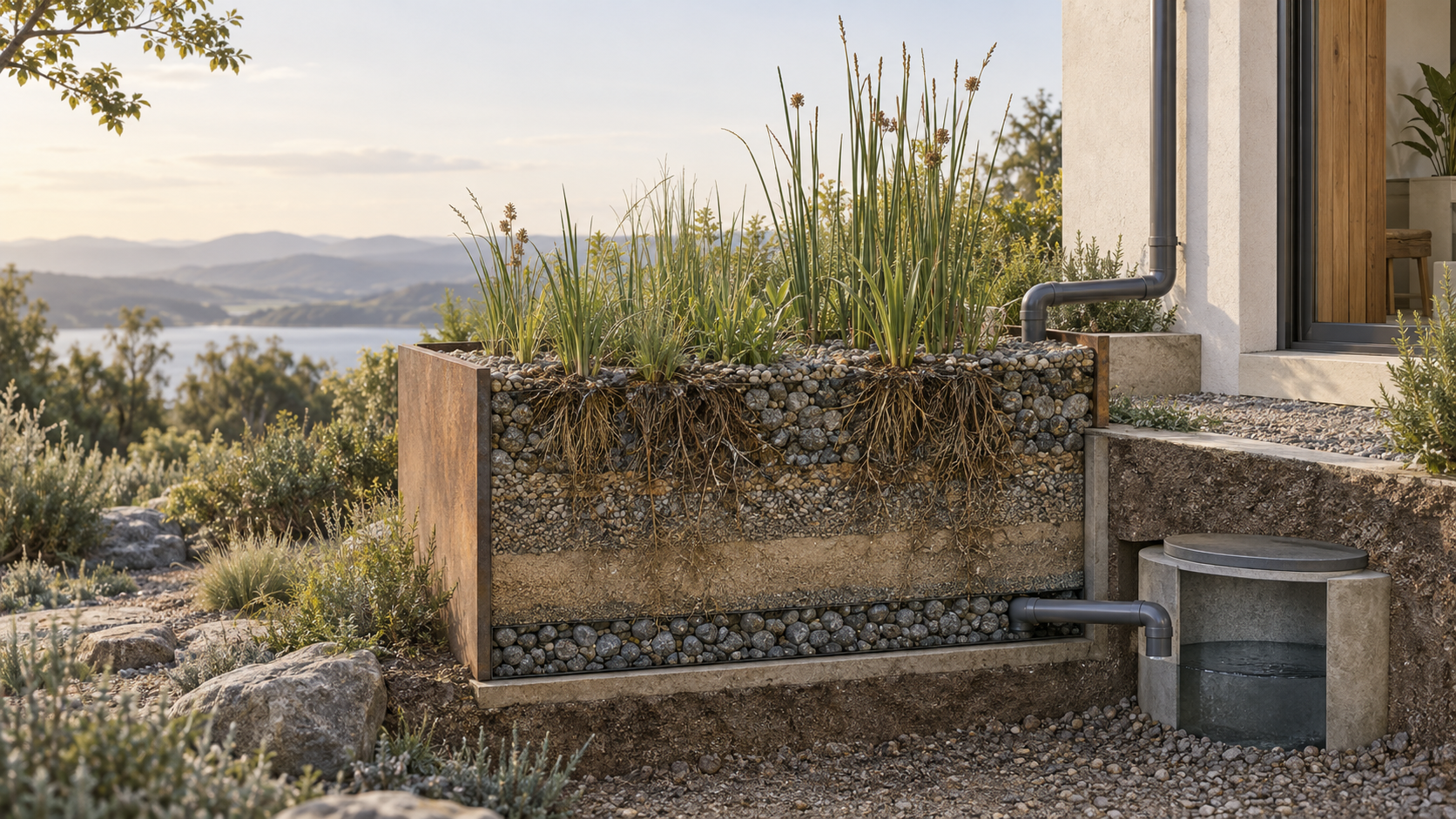
In a vertical-flow constructed wetland, greywater is distributed across the top of a planted filter and moves downward through layers of porous material, typically combinations of sand, gravel, or engineered media.
The bed is usually not kept permanently flooded. Water is applied intermittently, allowing pore spaces to drain and refill with air between doses. That alternation creates oxygen-rich conditions that support aerobic microbial processes and helps distinguish vertical-flow systems from permanently saturated wetland designs.
The distribution system matters. If water enters one corner repeatedly, only part of the bed performs useful treatment. A well-designed inlet spreads each dose across the filter so the available media can participate.
Below the surface, the system begins to look less like landscaping and more like a porous reactor.
The water disappears from view, but most of the treatment is only beginning.
The Real Treatment Happens Between the Grains
The plants are the most visible part of a constructed wetland. They are not the only treatment mechanism, and often not the dominant one.
As greywater moves through the bed, suspended particles are physically filtered. Dissolved substances interact with mineral surfaces. Organic matter becomes food for microbial communities growing as biofilms on grains, roots, and other submerged surfaces. Under suitable aerobic conditions, ammonia can be oxidized through nitrification. Other compounds may be transformed biologically, retained by the media, or taken up to varying degrees by plants.
Recent research has also examined modified media such as biochar and zeolite for improving removal of some micropollutants. A 2024 study of vertical-flow wetlands treating light greywater reported high removal of several investigated personal-care and pharmaceutical compounds when reactive materials were incorporated into the filter.
None of these processes acts alone.
Treatment emerges from contact time, oxygen, hydraulic loading, temperature, wastewater composition, filter material, microbial activity, and maintenance. The wetland works because water repeatedly encounters surfaces on its way through.
What the Plants Are Actually Doing
The planted surface still matters.
Roots and rhizomes occupy the upper media and create a biologically active zone around them. Plants contribute organic matter, alter local moisture conditions, provide extensive surfaces associated with microbial communities, and help make the treatment bed physically and visually part of a landscape rather than an exposed filter.
Different systems use reeds, sedges, rushes, ornamental wetland plants, or locally appropriate species. Plant choice should follow climate, hydraulic conditions, invasiveness risk, maintenance requirements, and treatment objectives rather than appearance alone.
It is also useful to resist a common visual misunderstanding. The plants are not simply drinking pollutants out of the wastewater.
A constructed wetland is a combined system of vegetation, porous media, microbes, water, air, and hydraulic control. Remove the media or overload the bed and healthy-looking plants cannot compensate for a failing treatment process.
The garden above can be beautiful.
The infrastructure below still has to work.
Cleaner Water Is Not Sterile Water
By the time greywater leaves a well-functioning constructed wetland, turbidity, suspended solids, biodegradable organic matter, and many other contaminants can be substantially reduced. Recent reviews describe vertical-flow and hybrid wetlands as effective low-energy treatment options for greywater, particularly when source streams and loading rates are matched to the design.
Pathogens require more caution.
Greywater can contain faecal microorganisms even when no toilet wastewater is connected to the system. Bathing, hand washing, laundry, and contaminated clothing can introduce bacteria and viruses. Constructed wetlands can reduce microbial concentrations, but removal is variable and may not be sufficient by itself for higher-contact reuse standards.
That is why a reuse train may continue beyond the wetland. Depending on the intended use and local regulations, polishing filtration or disinfection can be required before treated water enters storage or a separate non-potable distribution system.
A clear-looking effluent is not proof of microbiological safety.
The required treatment endpoint should be determined by what happens to the water next.
The Last Step Is Not Disposal
Once treated to an appropriate standard, greywater can enter a second life instead of a sewer.
Possible uses include toilet flushing, subsurface irrigation, landscape watering, and other non-potable demands where permitted. The appropriate reuse depends on treatment performance, local health requirements, plant and soil sensitivity, salinity, storage conditions, and the likelihood of human contact.
This changes the logic of a building's water system. Fresh potable water no longer has to perform every task, and wastewater is no longer treated as one uniform stream whose only destination is removal.
But decentralization also creates responsibilities. Screens require cleaning. Pumps and dosing equipment can fail. Filter surfaces can clog. Plants require management. Treatment performance can change when household occupancy, detergent use, or hydraulic loading changes. Cross-connections between potable and non-potable plumbing must be prevented.
The strongest greywater systems are therefore not the ones that hide their maintenance needs behind greenery.
They are the ones designed so those needs remain visible, accessible, and manageable.
A Building Can Have Its Own Small Water Cycle
The interesting thing about a small greywater wetland is not that it imitates a natural marsh.
It is that it changes where treatment happens.
Water can be used in a shower, intercepted before mixing with toilet wastewater, treated through a compact biological filter, polished where necessary, and returned to another useful task within the same building or site.
The distance between wastewater production and water reuse becomes metres rather than kilometres.
That does not make centralized sewerage unnecessary, nor does it mean every building should contain its own wetland. Density, climate, regulation, maintenance capacity, land availability, economics, and public-health requirements all matter.
But in water-scarce places, the sequence reveals an important possibility. The smallest useful unit of water management does not always have to be the city or the treatment plant.
Sometimes it can begin with a second pipe leaving the bathroom.
From knowledge to action
Practical applications
Separate suitable greywater sources from toilet wastewater before the streams mix.
Match pretreatment to the source so hair, lint, grease, and suspended solids do not prematurely clog the wetland.
Design the constructed wetland around actual hydraulic and pollutant loads rather than treating the planted area as decorative landscaping.
Select the final polishing, disinfection, storage, and distribution steps according to the intended non-potable reuse and applicable health standards.
Provide simple access for inspection, cleaning, pump maintenance, vegetation management, and eventual media rehabilitation.
Carry into the field
Questions for planners
Can source-separated greywater plumbing be incorporated when buildings are first designed rather than added later?
Which urban water demands genuinely require potable water, and which could safely use appropriately treated non-potable water?
Who is responsible for monitoring and maintaining decentralized treatment systems after construction?
References
Sources for continued reading.
- 01Source ↗
World Health Organization Regional Office for the Eastern Mediterranean. 2006. Overview of greywater management: health considerations. WHO-EM/CEH/125/E.
- 02Source ↗
Morandi, C. and Steinmetz, H. 2026. Constructed wetlands for greywater treatment: a review. Current Opinion in Environmental Science & Health 52: 100737.
- 03Source ↗
Arden, S. and Ma, X. 2018. Constructed wetlands for greywater recycle and reuse: A review. Science of the Total Environment 630: 587-599.
- 04Source ↗
Sacco, F. C. M., Venditti, S., Wilmes, P., Steinmetz, H., and Hansen, J. 2024. Vertical-flow constructed wetlands as a sustainable on-site greywater treatment process for the decrease of micropollutant concentration in urban wastewater and integration to households' water services. Science of the Total Environment 946: 174310.
- 05Source ↗
U.S. Environmental Protection Agency. Constructed Wetlands. Resources on treatment wetlands, design, operation, maintenance, and wastewater treatment applications.
Connected Knowledge
Continue through the relationships surrounding this record.