
Ancient Water Systems Were Built to Be Maintained
The endurance of ancient water infrastructure was not produced by construction alone. Water systems remained useful because people could enter them, clean them, remove sediment, repair masonry, restore channels, manage flows, and repeat the work when conditions changed.
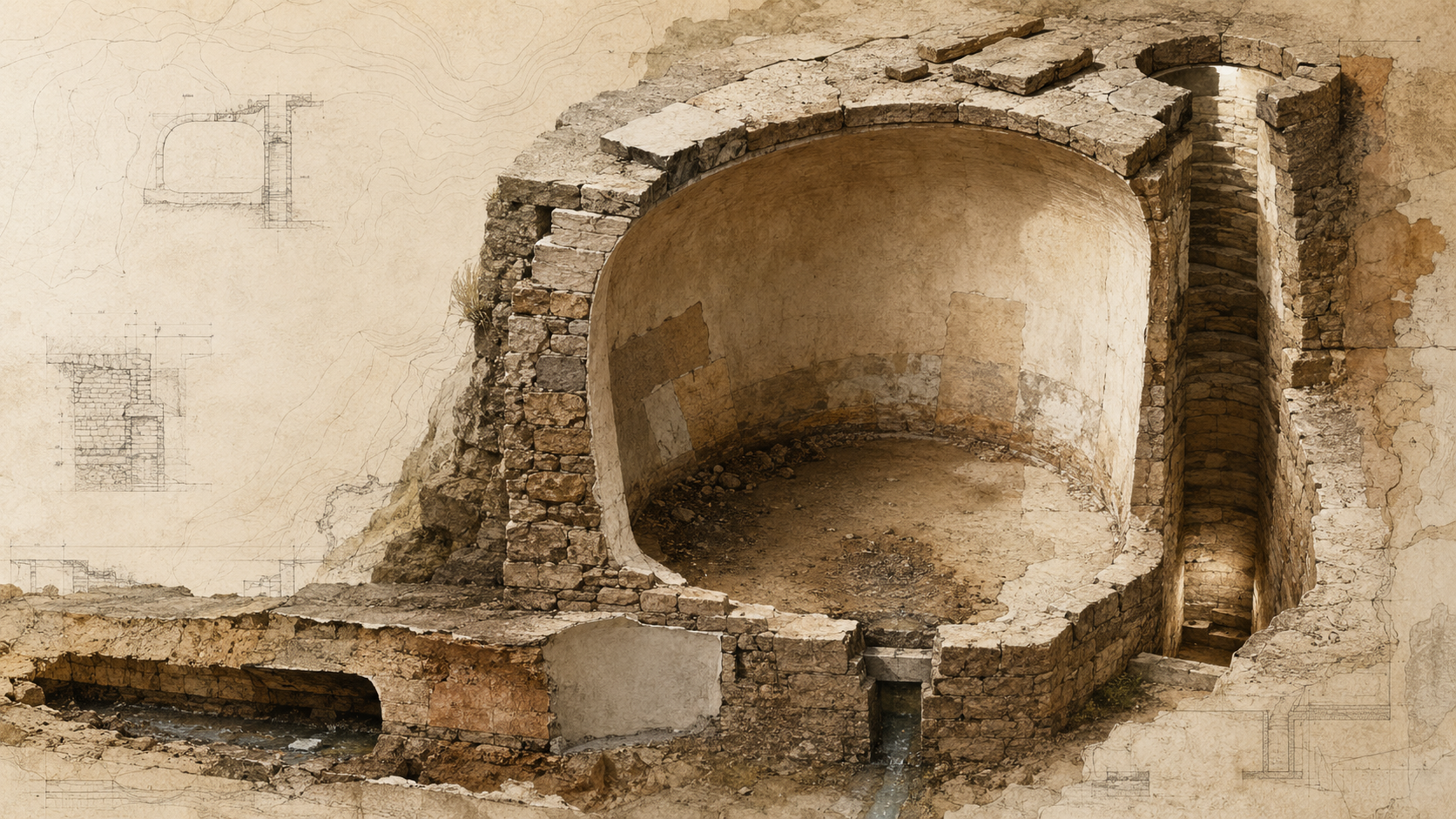
A historic lesson about maintenance as an integral part of water infrastructure. The guide reads access shafts, inspection openings, sediment traps, repair masonry, channel linings, overflow routes, and maintenance paths as evidence that water systems were designed for continued intervention rather than permanent completion. It connects archaeological observation with contemporary planning questions about accessibility, stewardship, repair, and the long-term operation of decentralized infrastructure.
- Written by
- mbtalafha
- Reading time
- 9 min read
Why this matters
A historic lesson about maintenance as an integral part of water infrastructure. The guide reads access shafts, inspection openings, sediment traps, repair masonry, channel linings, overflow routes, and maintenance paths as evidence that water systems were designed for continued intervention rather than permanent completion. It connects archaeological observation with contemporary planning questions about accessibility, stewardship, repair, and the long-term operation of decentralized infrastructure.
Infrastructure is never finished
Ancient water systems are often encountered as structures: a cistern cut into rock, a masonry channel, an underground gallery, a retaining wall, a reservoir, or a line of shafts crossing dry terrain. Their material survival can make them appear permanent.
Water infrastructure is operational rather than static. Channels accumulate sediment. Openings become blocked. Plaster cracks. Masonry shifts. Vegetation enters conduits. Floods redistribute material. Water quality changes. Users alter connections. Any system expected to continue functioning must accommodate intervention.
Historical and archaeological scholarship on ancient water technologies documents systems that combined construction with continued management, inspection, cleaning, and repair. Studies of qanats describe vertical shafts that remained useful after construction because they provided access for cleaning and maintenance, while ancient written evidence for Roman aqueduct administration records organized labor and institutional responsibility for maintaining conduits, reservoirs, and related works.
The historic lesson is not that ancient infrastructure was indestructible. It is that longevity depended partly on making deterioration visible, reachable, and repairable.
Access is part of the hydraulic design
An underground channel cannot be maintained if nobody can reach it. A cistern cannot be cleaned if its opening is too small or inaccessible. A blocked conduit cannot be repaired if the system offers no practical route to the obstruction.
This is why access structures deserve to be read as infrastructure rather than secondary architectural details. In qanat traditions, vertical shafts served construction, ventilation, removal of excavated material, and later access for cleaning and repair. Their repeated appearance along an underground gallery made the hidden system reachable from the surface.
Other water systems solve the same problem differently. Inspection openings, removable covers, settling chambers, accessible channel sections, maintenance paths, and reservoirs entered from above all create points where the system can be observed and worked on.
When documenting historic water infrastructure, ask not only how water moved through it. Ask how a worker could reach the places where problems were likely to occur.
Sediment is part of the operating environment
Water carries material. Runoff can transport sand, silt, organic matter, gravel, and debris into channels and storage structures. Groundwater conveyance systems can also accumulate deposits or experience local blockage. The longer a system operates, the more important these processes become.
Sediment should therefore be read as both a landscape process and a maintenance problem. A cistern may require cleaning because material settles at its base. A channel may lose capacity as deposits accumulate. A diversion structure may need repeated clearing after storm events. A tunnel may require dredging or removal of collapsed material.
Research on shaft-and-gallery systems shows that material removed during repeated maintenance can itself become part of the archaeological record. Deposits around access shafts may contain successive episodes of excavated material associated with construction and later cleaning.
The important planning insight is that sediment is not an exceptional failure. In many water systems, it is a predictable consequence of moving water through landscapes.
Repair marks are evidence of continued use
A perfectly uniform wall may tell less about long-term operation than a wall containing several generations of repair. Changes in stone size, mortar, plaster, lining thickness, construction technique, or channel geometry can indicate that infrastructure was repeatedly adjusted rather than preserved in its original form.
Look for patched plaster inside storage structures, inserted stones, rebuilt wall sections, narrowed channels, replacement slabs, secondary openings, blocked branches, enlarged access points, and surfaces showing more than one construction phase.
These differences should not automatically be assigned dates or causes from appearance alone. Their value lies first in demonstrating change. The water system had a history after construction.
A repair can therefore be interpreted as evidence of infrastructure still being negotiated with water, sediment, materials, users, and changing conditions.
Gravity reduces energy, not responsibility
Many historic water systems used gravity to move water across terrain. Once appropriate levels and gradients were established, water could travel without mechanical pumping. That does not mean such systems operated without labor.
Gravity-fed infrastructure remains vulnerable to blockage, leakage, erosion, structural damage, sedimentation, changes at intakes, and alterations along the route. The hydraulic principle may be simple while the operational landscape remains complex.
Broad histories of ancient water technology describe systems in which catchment, conveyance, storage, distribution, and management were integrated across settlements and landscapes. Their durability is better understood through this complete operational chain than through individual monuments alone.
The distinction is useful for contemporary planning. Low-energy infrastructure is not maintenance-free infrastructure.
Maintenance requires organization as well as access
Physical access makes maintenance possible, but somebody still has to perform the work. Water infrastructure therefore has a social and administrative dimension alongside its hydraulic and architectural dimensions.
Ancient written evidence from Roman water administration describes officials, workers, records, measurement, and organized responsibility associated with operating and maintaining a large urban water system. Qanat scholarship similarly treats construction and maintenance as bodies of specialized knowledge rather than as isolated acts of excavation.
The details vary greatly among periods, institutions, and technologies, so these traditions should not be collapsed into one management model. What they share is a basic infrastructural principle: a physical system and the arrangements that sustain it cannot be understood separately.
A channel without stewardship can become an archaeological feature much faster than a channel with an active maintenance system.
Look for the maintenance landscape
Maintenance can leave traces beyond the hydraulic structure itself. Repeated access may create paths. Shaft cleaning can produce mounds of excavated material. Reservoirs may require working space around openings. Channels may have reachable edges or intervals where covers can be removed. Repair stone may be stored nearby. Vegetation may be cleared along particular routes.
These features expand the spatial extent of the water system. A narrow underground conduit may depend on a much wider surface corridor because workers need to reach its access points. A cistern may require an open area above it even though its storage volume is underground.
When these supporting spaces are severed by construction, subdivision, road building, or changes in ownership, the hydraulic structure may remain physically intact while becoming increasingly difficult to operate.
For field observation, the maintenance route can be as important as the water route.
A field sequence for reading maintenance
Trace the water system from catchment or source through conveyance, storage, distribution, and overflow Identify every place where a person could inspect or enter the system Look for shafts, access openings, removable covers, settling spaces, and reachable channel sections Record sediment deposits, blocked sections, staining, erosion, vegetation intrusion, and collapsed material Document differences in masonry, plaster, lining, channel width, and construction technique that may indicate repair or alteration Map paths and working spaces associated with access points Look for places where maintenance access has been obstructed by later construction or land-use change Distinguish original construction from later intervention only where evidence supports that interpretation Photograph both functioning relationships and points of deterioration Map maintenance infrastructure together with hydraulic infrastructure rather than as separate categories
Trace the water system from catchment or source through conveyance, storage, distribution, and overflow
Identify every place where a person could inspect or enter the system
Look for shafts, access openings, removable covers, settling spaces, and reachable channel sections
Record sediment deposits, blocked sections, staining, erosion, vegetation intrusion, and collapsed material
Document differences in masonry, plaster, lining, channel width, and construction technique that may indicate repair or alteration
Map paths and working spaces associated with access points
Look for places where maintenance access has been obstructed by later construction or land-use change
Distinguish original construction from later intervention only where evidence supports that interpretation
Photograph both functioning relationships and points of deterioration
Map maintenance infrastructure together with hydraulic infrastructure rather than as separate categories
Design contemporary infrastructure for the second intervention
The historical lesson becomes useful when attention shifts from construction to the life of a system after completion. A decentralized cistern, bioswale, drainage channel, infiltration basin, culvert, irrigation network, or underground conveyance will eventually require inspection and intervention.
The planning question is therefore not only whether the infrastructure can be built. It is whether the second worker can reach it years later. Can sediment be removed? Can a blocked inlet be opened? Can a liner be repaired? Can equipment reach the site? Can an inspection cover remain accessible after landscaping matures? Is responsibility for maintenance clear?
Historic water systems do not provide ready-made solutions for contemporary engineering. Their value lies in exposing a principle that modern projects still confront: infrastructure that cannot be maintained is only temporarily functional.
Designing for maintenance means treating access, stewardship, repair, monitoring, and replacement as part of infrastructure from the beginning rather than as operational problems left for the future.
From knowledge to action
Practical applications
Map inspection and maintenance access whenever documenting historic or contemporary water infrastructure.
Include sediment removal, cleaning, repair, and replacement routes when reviewing decentralized water systems.
Protect access corridors to buried infrastructure rather than preserving the hydraulic structure while allowing its maintenance space to disappear.
Use repair scars and material changes as evidence of continued intervention without assigning dates or causes that have not been verified.
Design cisterns, drainage structures, infiltration systems, and channels with reachable inspection points and adequate working space.
Treat sediment accumulation as a predictable operational process when planning water-harvesting and stormwater systems.
Record who is expected to maintain infrastructure, how frequently intervention may be required, and what equipment or access that work requires.
Use GIS to map maintenance points, access routes, storage structures, channels, and responsibility boundaries as one operational network.
Evaluate heritage water systems through both hydraulic continuity and maintainability when assessing their present condition.
Ask how contemporary infrastructure can be repaired incrementally rather than requiring complete replacement when one component fails.
Carry into the field
Questions for planners
Where can this water system actually be inspected?
How would sediment or debris be removed after years of operation?
Which components are likely to fail, clog, crack, erode, or become inaccessible first?
Does the physical layout preserve enough space for future maintenance?
What evidence of previous repair or alteration is visible in the existing system?
Are maintenance routes protected as carefully as water routes?
Who holds the knowledge, authority, and responsibility required to keep the infrastructure functioning?
Would later subdivision, construction, landscaping, or changes in ownership obstruct access to important components?
Is the system being designed for completion day, or for the repeated interventions that will follow?
References
Sources for continued reading.
- 01Source ↗
Mays, L. W., editor. 2010. Ancient Water Technologies. Springer. A broad technical and historical synthesis of ancient water collection, conveyance, storage, distribution, and management technologies.
- 02Source ↗
Angelakis, A. N., Mays, L. W., Koutsoyiannis, D., and Mamassis, N. 2012. Evolution of Water Supply Through the Millennia. IWA Publishing. A comparative history of water-supply technologies and management across ancient societies.
- 03Source ↗
Semsar Yazdi, A. A. and Labbaf Khaneiki, M. 2017. Qanat Knowledge: Construction and Maintenance. Springer. A detailed treatment of qanat construction, rehabilitation, tools, maintenance, preservation, and associated structures.
- 04
Frontinus, S. J. 1925 edition. The Aqueducts of Rome, in The Stratagems and The Aqueducts of Rome, translated by Charles E. Bennett, with the aqueduct translation revised from Clemens Herschel. Loeb Classical Library 174. The text provides direct historical evidence concerning administration, measurement, repair, and maintenance of a major ancient urban water system.
- 05
Hodge, A. T. 1992. Roman Aqueducts and Water Supply. Duckworth. A comprehensive technical study that interprets aqueducts as functioning water systems including catchment, conveyance, distribution, hydraulics, and operation.
Connected Knowledge
Continue through the relationships surrounding this record.
Follow what this record touches next.
Ideas
Planning concepts and methods influence what planners notice, measure, value, and act upon.
Continue →