
The Thermal Memory of a City: Why Heat Does Not End at Sunset
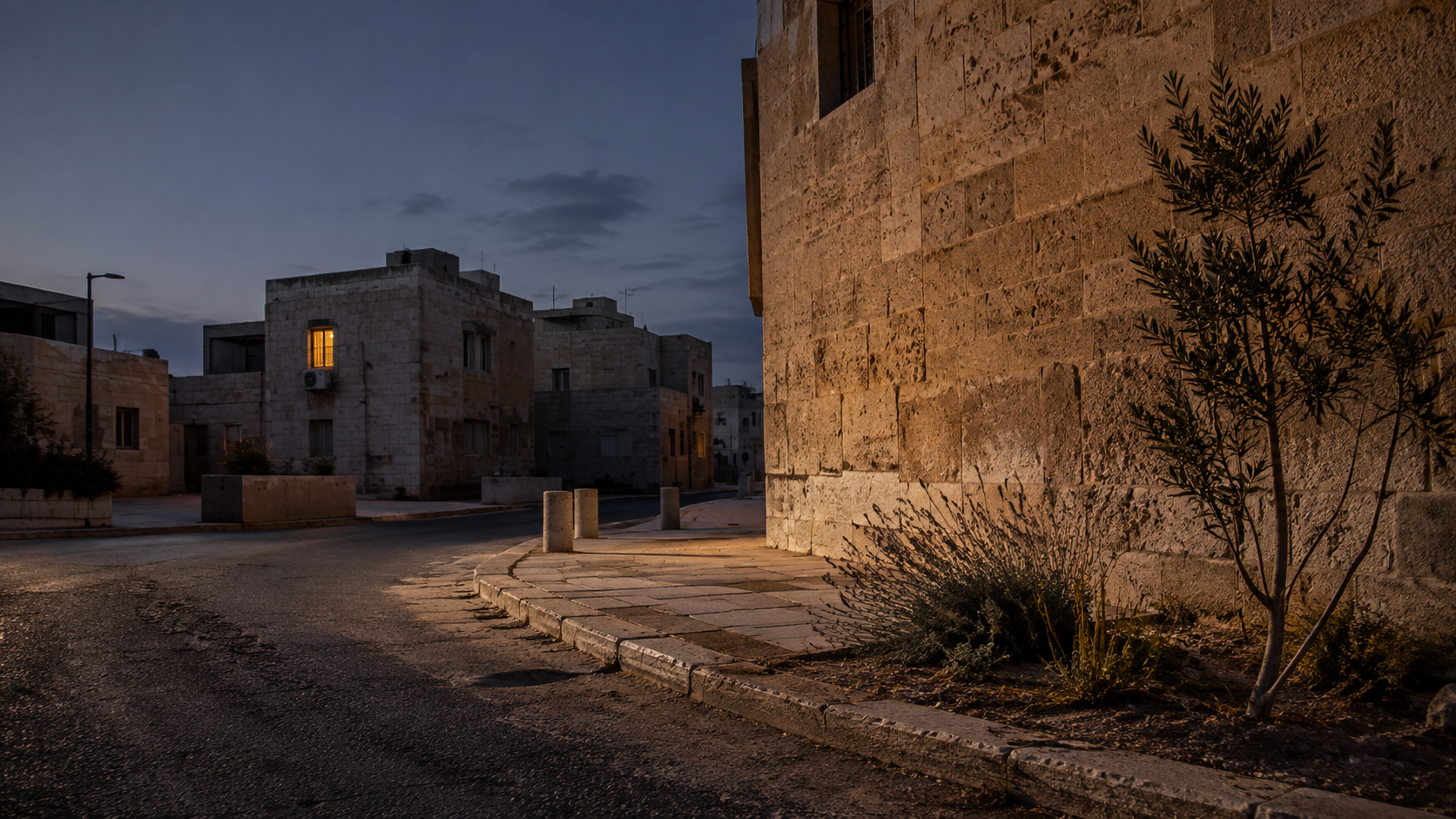
After sunset, asphalt, walls, roofs, and pavements begin returning the heat they absorbed during the day. A hot city does not simply cool. It remembers.
A short climate essay about nighttime urban heat and the thermal memory of the built environment. The piece follows the heat stored in streets and buildings through the evening, asks why warm nights matter biologically, and considers why adapting to hotter cities requires protecting the hours when bodies, buildings, and landscapes are supposed to recover.
- Written by
- mbtalafha
- Reading time
- 5 min read
Why this matters
A short climate essay about nighttime urban heat and the thermal memory of the built environment. The piece follows the heat stored in streets and buildings through the evening, asks why warm nights matter biologically, and considers why adapting to hotter cities requires protecting the hours when bodies, buildings, and landscapes are supposed to recover.
When the Day Refuses to End
There is a familiar expectation built into evening: the sun disappears and the heat should begin to leave with it.
In an open landscape, cooling can become noticeable soon after sunset. Surfaces lose energy to the atmosphere and sky, vegetation continues exchanging water and heat, and the boundary between day and night becomes physically perceptible.
Cities complicate that transition.
Roads, roofs, walls, parking areas, and buildings spend the day absorbing solar energy. Dense urban geometry can also reduce airflow and restrict the amount of sky visible from streets and courtyards. When the sun goes down, much of the stored heat remains.
The result is not simply a hot afternoon extended by a few hours. Night becomes its own thermal environment.
Urban climate research has long shown that heat islands are often especially pronounced after sunset. Recent work continues to identify heat storage as one of the important mechanisms behind stronger nighttime urban warming.
The city has spent the day collecting energy. Evening is when part of that energy comes back.
The City Gives the Heat Back
Concrete, stone, brick, asphalt, soil, vegetation, and water do not respond to sunlight in the same way.
Built materials can absorb substantial amounts of energy during the day and release it gradually after solar radiation declines. At night, this stored heat becomes part of the energy exchanged between surfaces and the air above them. Research on urban heat islands identifies the contrast in heat storage between built and less urbanized landscapes as an important driver of nighttime temperature differences.
Vegetation changes the balance in another way. Where water is available, plants can use part of the incoming energy for evapotranspiration rather than storing it entirely as sensible heat. Shade can also prevent surfaces from heating as strongly in the first place.
This is why two streets experiencing the same regional weather can feel very different after dark. One may contain deep shade, soil, vegetation, permeable surfaces, and open airflow. Another may be dominated by asphalt, masonry, parked vehicles, mechanical equipment, and walls that have been exposed to sunlight for hours.
At sunset they do not begin cooling from the same starting point.
The material history of the day remains embedded in the evening.
Night Is Supposed to Be the Recovery Window
The importance of a cool night is not only meteorological.
Human bodies also depend on the daily decline in temperature. Night provides an opportunity to reduce accumulated heat stress, sleep, and recover before the next period of exposure. When temperatures remain elevated through the night, that recovery becomes more difficult.
A 2025 multicountry analysis using hourly temperatures from 178 locations across 44 countries found that hotter nights were associated with an additional mortality risk even after accounting for daytime maximum temperature. A 2026 review of nighttime heat research similarly highlighted sleep disruption, impaired thermoregulation, and health impacts as reasons nocturnal heat deserves attention as a distinct hazard rather than simply an extension of daytime heat.
The World Health Organization emphasizes nighttime cooling in its heat guidance for the same reason. Homes are easier to manage during extreme heat when cooler outdoor air becomes available after dark. When the outside temperature remains high, one of the simplest passive cooling opportunities disappears.
A heatwave without a cool night is therefore different from a sequence of hot afternoons.
The body is asked to begin the next day before it has fully escaped the previous one.
Designing for the Hours After Sunset
Much of the visual language of heat adaptation is daytime language: shade trees, canopies, reflective surfaces, fountains, cool pavements, green roofs.
These interventions can matter enormously, but nighttime heat adds another question. What happens to the energy after the sun disappears?
A tree that shades a wall during the afternoon can reduce how much heat that wall stores for release later. Vegetated ground can change both daytime energy exchange and evening cooling. Material choices influence heat absorption and storage. Building spacing and street geometry affect ventilation and the amount of longwave radiation that can escape toward the sky. Mechanical cooling can protect indoor occupants while also releasing waste heat outdoors and increasing electricity demand.
There is no single object that solves nighttime heat. It is produced by the cumulative thermal behaviour of surfaces, buildings, vegetation, air movement, water, energy use, and regional weather.
That makes the night an unusually revealing way to read a city.
Walk the same street at noon and again several hours after sunset. Touch a stone wall. Stand above asphalt, then beside irrigated vegetation. Move from a narrow enclosed street into an open space where more sky is visible. Notice where air begins to move and where heat seems to remain trapped.
The sun is already gone.
What you are feeling is the memory of the day.
References
Sources for continued reading.
- 01Source ↗
Li, C., Zhang, N., Ren, K., and colleagues. 2024. Biophysical Drivers of Seasonal Hysteresis of Urban Heat Islands Across Climates and Urban Landscapes. Journal of Geophysical Research: Atmospheres 129, e2023JD040446.
- 02Source ↗
Royé, D., Sera, F., Tobías, A., and colleagues. 2025. Short-term association between hot nights and mortality: a multicountry analysis in 178 locations considering hourly ambient temperature. Environment International 203: 109719.
- 03Source ↗
Gong, P., Liu, Q., Lin, X., Lin, Y., Xu, H., and Lan, L. 2026. Action on hot nights: A scoping review of nighttime heat thresholds and their critical role in urban climate resilience. Sustainable Cities and Society 142: 107303.
- 04Source ↗
World Health Organization. 2026. Heat and health.
- 05Source ↗
World Meteorological Organization. Urban heat islands discussion in Air Quality and Climate Bulletin coverage of heatwaves and pollution.
Connected Knowledge
Continue through the relationships surrounding this record.