
The Dark Skin of Stone: Desert Varnish in Wadi Rum
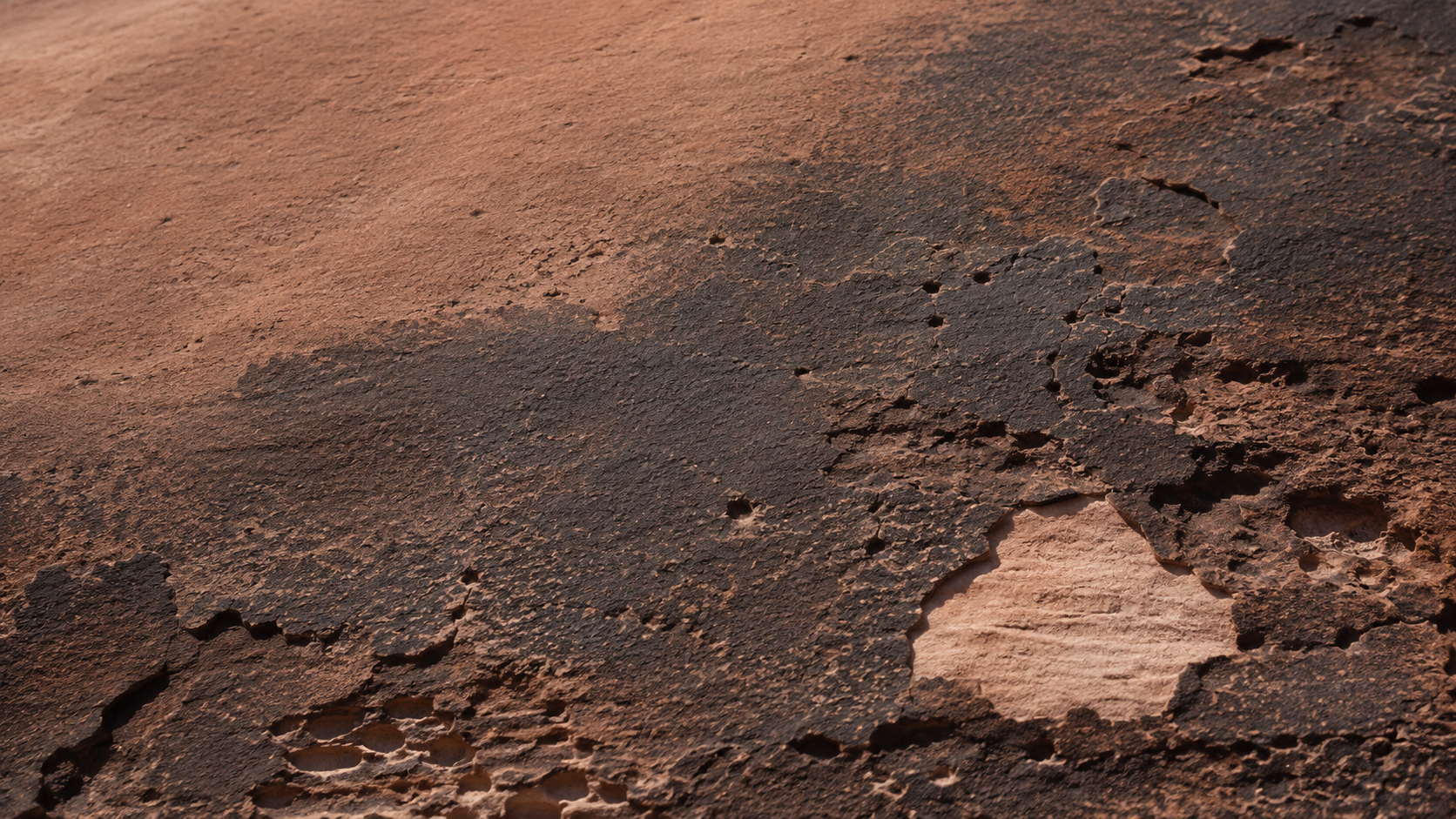
Some of Wadi Rum's darkest surfaces are not the colour of the sandstone itself. They are thin mineral-rich coatings assembled slowly at the boundary between rock, dust, water, atmosphere, and microscopic life.
A close reading of desert varnish in Wadi Rum, Jordan, from its clay, iron, and manganese-rich composition to the unresolved question of how it forms. The article also considers the relationship between dark rock coatings, weathering, and the extraordinary record of petroglyphs and inscriptions preserved across the protected landscape.
- Written by
- mbtalafha
- Reading time
- 5 min read
- Place
- Wadi Rum Protected Area, Aqaba
In this guide
Why this matters
A close reading of desert varnish in Wadi Rum, Jordan, from its clay, iron, and manganese-rich composition to the unresolved question of how it forms. The article also considers the relationship between dark rock coatings, weathering, and the extraordinary record of petroglyphs and inscriptions preserved across the protected landscape.
The Dark Skin of Sandstone
Wadi Rum is usually remembered through colour: red sandstone, pale weathered cliffs, ochre sand, dark shadow. Look closely at some exposed rock surfaces, however, and another colour appears. Thin brown to nearly black coatings lie across the stone like a skin.
This is rock varnish, often called desert varnish when it is especially visible in dry landscapes.
The distinction matters because the dark surface is not simply the colour of the rock beneath it. It is an accretion that develops on exposed stone over time. Wadi Rum's landscape is built from continental sandstones shaped by tectonics, drainage, salt weathering, erosion, biological processes, and climatic histories extending far beyond the conditions visible today. The varnished surface belongs to that continuing story of weathering.
It is easy to pass it without noticing. Once noticed, the rock becomes less like a solid object and more like a surface under construction.
The Coating Is Thinner Than It Looks
Rock varnish can appear visually heavy, but microscopically it is remarkably thin. Studies commonly describe coatings ranging from only a few micrometres to a few hundred micrometres in thickness.
Its principal ingredients are not exotic. Fine clay minerals make up much of the material, while manganese and iron oxyhydroxides help bind and colour the coating. Manganese-rich varnish tends toward darker brown and black tones, while iron contributes reddish and brown components.
This creates an interesting inversion of scale. A surface that can change the visual character of an entire boulder may be thinner than a sheet of paper.
The coating also does not replace the underlying sandstone. It sits upon it, grows into microscopic irregularities, and develops its own fine layering. Under magnification, what looks from several metres away like a uniform dark stain becomes a small mineral architecture.
Field figure
Wadi Rum Landscape
Wadi Rum Landscape
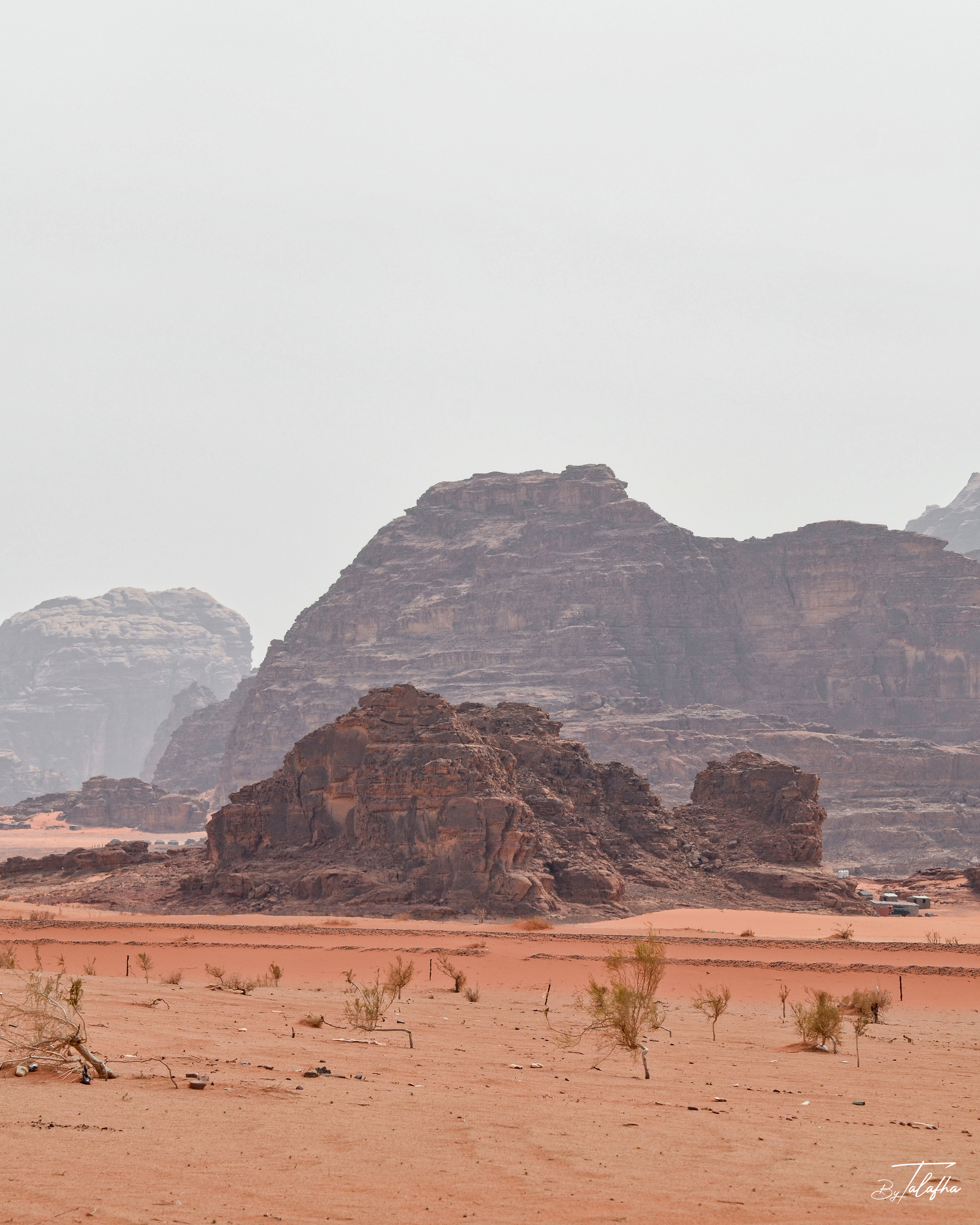
Wadi Rum Landscape
A Surface Built From More Than One Process
The origin of rock varnish has resisted a simple explanation.
Airborne dust supplies fine clay and mineral particles. Intermittent moisture allows chemical reactions and the movement of dissolved elements across the rock surface. Iron and manganese become concentrated within the coating. Microorganisms are also repeatedly found living in varnished surfaces, and several studies have identified diverse bacterial communities associated with them.
But finding microorganisms inside varnish does not mean that varnish can be explained as a purely biological product. Recent reviews of the field continue to challenge single-process explanations. Rock varnish appears to emerge from an interaction among mineral deposition, wetting and drying, chemical weathering, dust, surface conditions, and biological activity.
That uncertainty is part of what makes the material interesting. The coating looks simple because it is thin. Its formation is complicated because the rock surface is a meeting place for atmosphere, geology, water, and life.
When the Dark Surface Is Broken
A varnished rock becomes especially legible where its surface has been cut, chipped, scratched, or eroded.
Removing the dark coating can expose lighter stone beneath it, producing a strong contrast. Across desert landscapes, that contrast has long made varnished surfaces suitable for rock engraving. Wadi Rum preserves an exceptional concentration of petroglyphs and inscriptions on boulders, stones, and cliff faces, part of a cultural record extending across thousands of years.
The relationship between varnish and engraving is visually powerful, but it needs careful interpretation. Not every dark rock face is varnish, not every inscription was made by removing a varnished coating, and the colour contrast visible today may have changed through later weathering.
Still, the surface itself becomes part of the archaeological object. An engraving is not only a line cut into stone. It is also a disruption in a weathered interface that continues to change after the mark is made.
A Record, But Not a Simple Clock
Because rock varnish grows slowly and can contain extremely fine layers, researchers have explored it as a record of surface exposure, environmental change, and past climatic conditions. This has also created repeated attempts to use varnish in archaeological and geomorphological dating.
The attraction is obvious: if a surface develops varnish gradually, perhaps the coating can tell us how long that surface has been exposed.
In practice, the relationship is much less direct. Growth rates vary, varnish may begin forming only after a delay, chemical elements can be redistributed, and different microenvironments on the same rock can develop differently. Modern reviews therefore warn against treating varnish thickness or chemistry as a straightforward stopwatch.
Its value is subtler. Rock varnish is evidence that apparently bare stone is not inert. A cliff face can receive dust, hold moisture, support microbial communities, concentrate minerals, weather, darken, be carved, and weather again.
In Wadi Rum, where geology and human inscription occupy the same surfaces, that thin dark skin makes the boundary between environmental history and cultural history unusually visible.
References
Sources for continued reading.
- 01Source ↗
UNESCO World Heritage Centre. Wadi Rum Protected Area.
- 02Source ↗
Dorn, R. I. 2024. Rock varnish revisited. Progress in Physical Geography: Earth and Environment 48(3): 389-419.
- 03Source ↗
Kuhlman, K. R. et al. 2019. Taxonomic and functional insights into rock varnish microbiome using shotgun metagenomics. FEMS Microbiology Ecology 95(12): fiz180.
- 04Source ↗
Krinsley, D. 1998. Models of rock varnish formation constrained by high resolution transmission electron microscopy. Sedimentology 45(4): 711-725.
Connected Knowledge
Continue through the relationships surrounding this record.
Follow what this record touches next.
Land
Land records relationships between ecology, ownership, terrain, history, biodiversity, and development.
Continue →